

I Drove the Original Tesla Model G in 2008 (Part 2)
The dirty business of dumpster grease.

Each week, a menu of sorts, around a revolving theme. This week: On the road, fueled by veggie oil.
If you haven’t yet, please subscribe to Suppertime! I promise to feed you only once a week (or two), and never after midnight.
AI Disclaimer
For this publication, I pledge to never use AI for the purposes of brainstorming, organizing, reorganizing, editing, cleaning up, rewording, writing, or generating anything other than what comes out of my own head and hands. Because of that, you will likely find plenty of errors and redundancies and grammatical mistakes. It may also run long because this is a first draft and I can’t self-edit for sh*t.
Course 1
A Word of Gratitude: Dinner Date
Last week, I gave you the origin story of my years spent driving a Model G. That is, the Greasemobile in which my touring band traveled the country, a Ford E350 diesel van converted to run on vegetable oil. As I was writing the story, I realized it was pushing 3,000 words and decided to split it up into two installments. You should probably read the other one first, but if you just want the trials and tragedies part, then by all means continue onward.
Just to reiterate: A few weeks ago, I drove a Tesla Model Y for the first time when I arrived in Florida and was upgraded from whatever cheap compact car I had originally selected. (Note: I cannot stress this enough, but do not ever rent a car from Budget as they are a dishonest scam of a company.)
Truthfully, it was a bad idea to just grab the keys and figure it all out in the middle of a parking garage. There are nuances to driving a Tesla, things like tapping a card to start and using a touch screen for everything. There’s also the whole feeling of sitting inside of a rocket ship when the acceleration pedal is pressed to the floor and the car takes off in a way that feels like it’s breaking laws of physics. Effortlessly smooth as it pins the back of your skull to the headrest. No matter your stance on Tesla, what they’ve done with a battery powered car is an incredible feat of engineering.
Then there’s the brakes, or lack thereof. The car uses regenerative braking, which I had never experienced. While decelerating, the car automatically brakes, prompting the powertrain to capture its kinetic energy and convert it to battery power. Meaning, you almost never have to switch pedals. It’s jarring at first, but after a few days of driving this way, I wished my Subaru Outback harnessed the same technology.
There were downsides. Mostly, I hate that it felt nothing like a car. Little ground feel. No character. Navigating through multiple layers of screens to get what I wanted. Who asked for this, by the way? Was it really so horrible to have a tachometer? Was it a cumbersome chore to turn a knob for the stereo volume or air conditioning level? I don’t want my dashboard to look the padded walls of a sanatorium, like the hallways of Lumen Industries.
Then there was the interior quality, which was absolute garbage. Faux wood paneling peeling off and a generally cheap tactile feel all around. It didn’t help that this particular rental steering wheel was patched up with electrical tape. It just felt so temporary, so throwaway, like an Instagram reel on wheels. A Zara car-a. In 40 years, nobody will be rolling up in an original body Tesla to the Saturday coffee and cars meetup. It’s just designed to be disposable. And that’s sad.
Finally, the charging thing. Much like any battery on any device these days, nobody is really sure what’s drawing the power down and to what degree. If I leave an app on in the background, suddenly my power drops by 10%. Don’t accidentally touch the screen brightness or the autopilot or run the windshield wipers during a light mist.
We had been driving the car for a few days, and at some point the battery icon went from displaying the remaining mileage (useful) to displaying the remaining battery percentage (not useful). I had no idea how to quantify the remaining charge, so it was up to hopes and prayers.
“When should you charge it?” my wife asked, on a rare evening when we procured a date night in downtown Fernandina Beach. My mother-in-law was watching our kids, so we took the car to dinner, then to the southern end of Amelia Island. The battery level went down, starting above 25% then pulling a Benjamin Button as it slipped into the teens faster than I thought it should have. As with all electronic devices I own, I had zero intentions of charging anything above 10%. But I was in uncharted territories, so it was time to look for a charger.
I pulled up the charging map on the Tesla home screen. There was one a few miles away. When we arrived, we were in a valet roundabout at the entrance to the Ritz Carlton hotel on a Saturday night. No charger in sight, so I quickly exited, convinced we had plenty of time. The next charger was nearly 20 miles away, and while it was free, I had to download an app to access it. The battery dwindled to 15%, the same level as my phone.
Ten minutes later, I tapped the app and was able to unlock the charging handle. With all the anxiety of a zookeeper trying to keep the pandas from going extinct, I guided the male part to the female part. But like a virgin drunk off Mad Dog 20/20 on prom night, it wouldn’t go in. I tried every way, but the charger would not fit.
I looked it up on YouTube on my quickly dying phone. Turns out, there are a variety of different chargers for proprietary charging modules. Some people have a whole trunk full of adapters. I, of course, did not have one of those.
I pulled up the map again. Nothing within 20 miles. This can’t be real, I thought. I see Tesla Superchargers everywhere back home. So I pulled out my phone and opened Google Maps. Searched for superchargers. A whole arsenal of them sat across the street at Wawa.
We pulled up next to all the other robots, and with only 10% left on the battery, I had it just where I wanted it. And I charged it.
For that, I am grateful.
Course 2
The Main: Don’t Go Chasing Grease Waterfalls
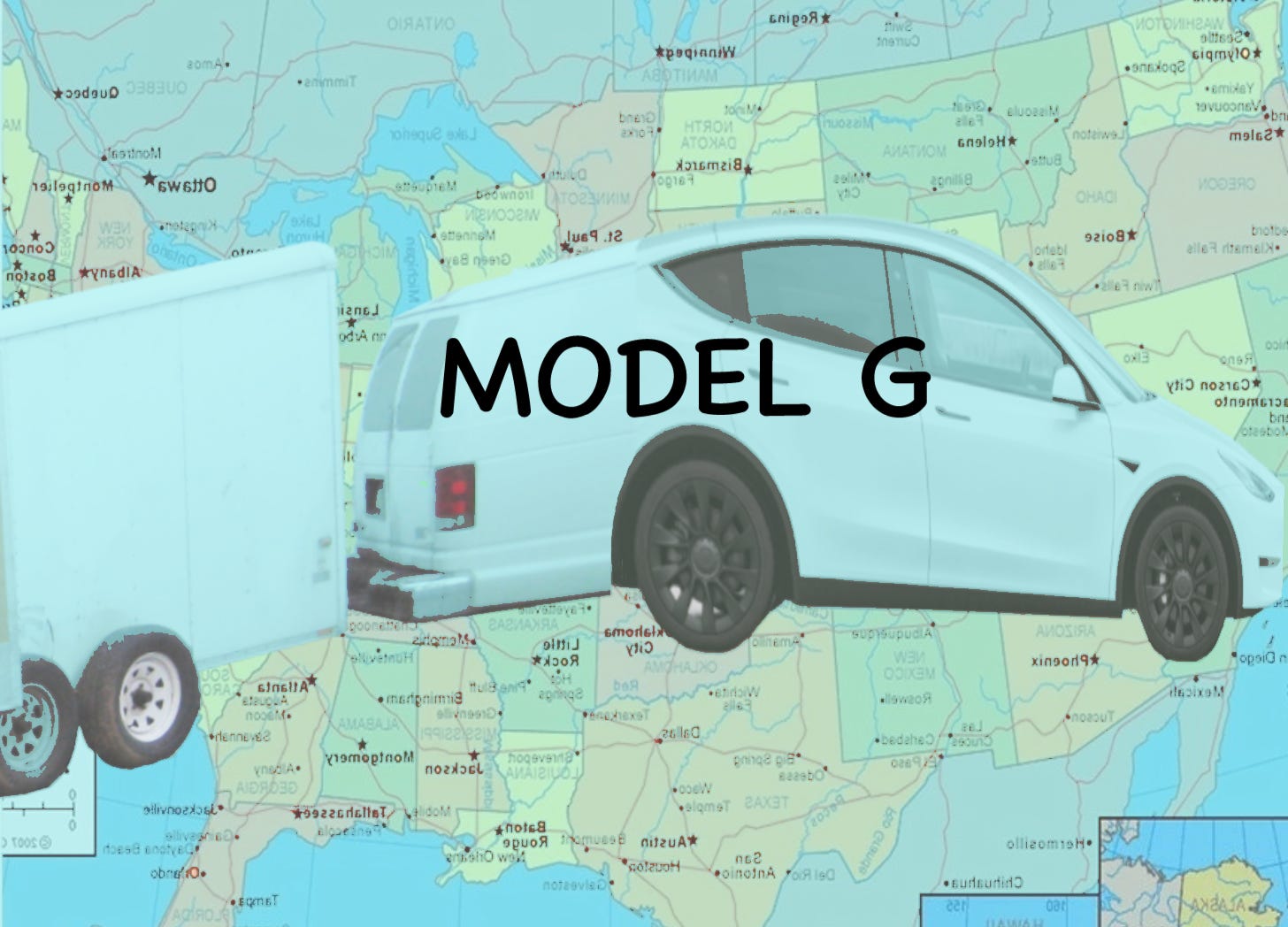
Which brings me back to the original Tesla G from Part 1 of this saga: the Greasemobile.
As I sat with my wife in our Tesla rental, waiting for our car to charge behind a random Wawa in the outskirts of suburbia, I realized I had been here before. Searching for fuel in random places, worried about running out, finally finding it before sitting around bored while the fuel transfer took place.
I was reliving the cycle of grease hunting.
Before my band converted our first vehicle to run on vegetable oil, we imagined ourselves as a merry band of Rumplestiltskins, drawing golden grease flowing from a flock of golden geese. We show up to a dumpster, we pump out the grease– boom– free fuel. Coming from a diesel van pulling a dual-axle trailer that got 10 miles per gallon, we were on the verge of becoming thousandaires.
The reality of free fuel was much different.
Our first vehicle was an already-abused shuttle bus, with the grease tanks custom fabricated to fit on the underside of the vehicle. The pumping system still consisted of a hose that ran to an initial filter, then went into the fuel tank, then back through another filter before heading to the engine. It could still run on diesel, which we did to start and end the engine, but why use diesel when you have a bounty of grease all around you?
Turns out that bounty was more of a buried treasure. Despite every restaurant in America having a dumpster for used grease, good grease– just like a good man– is hard to find.
If the grease is full of impurities and fried to the gills, packed with bits of food and left open to the elements, it’s pretty much useless. Yes, you could still run a vehicle on it, but you’ll burn through filters and eventually clog up fuel injectors and pistons which would offset any savings.
Good grease was so rare that we had a hand-written, spiral-ringed address book devoted to which restaurants had good grease on the East Coast. It felt like we were always hunting for good grease. What did this look like?
First off, we split our band into two teams of two, depending on the tour. Each team was responsible for filling the 120-gallon grease tank, ensuring we’d make it to the next couple shows free of charge. Let me tell you, there was nothing worse than grease duty.
It seemed to consume our waking hours. If we had an off day or a free afternoon, it meant going out for grease. If we had a drive first thing in the morning, it meant someone had to be sober (enough) after a show to go search for grease. If we had an hour between sound check and the show, we’d poke around grease dumpsters just to see if we could top off the tank.
It was technically illegal to poach used grease, because waste and animal feed companies pay to take it. Which meant that we usually went into a restaurant and tracked down the manager, asking if we could take their grease (much to their confusion). We typically respected their wishes, but if we were in dire straits, we’d just go back at night and steal it. And if we were on a nighttime raid, all bets were off. We just took what we could find.
This means I’ve been in more dumpster areas and seen more backs of strip malls than almost anyone alive, and I don’t think that’s an exaggeration.
When we rolled up to a dumpster area, the passenger would jump out and open the lid of the grease trap, doing an eye check for both quantity and quality. Right away you could tell if it was remotely usable. If it looked good, we grabbed the long dipstick from the back of the van and plunged it to the bottom before pulling it back up. If a white strand came up, this would reveal any water settled into the grease. A little bit was okay, but too much rendered it useless. Same with impurities or used food bits.
If it looked good, we’d drop the hose in, flick the switch on the dash and start pumping it out. That was the best case scenario, which rarely happened. Searching for grease was pure luck. Sometimes you’d go out and find a full dumpster on your first try. We’d come back to wherever we stayed 45 minutes later with arms triumphantly raised, the other half of the band seething with envy.
Usually it meant driving around aimlessly, lifting dumpster lids one after another, coming up empty for hours.
I remember one day in particular, stuck in Texas during a brutal heat wave. It always seemed like we were in Texas in August, except for the time we were in Texas in January and it actually snowed. It still remains shocking to me that the groundwater just doesn’t get cold there in the summer months.
Obviously we didn’t wake up early since we almost always stayed up til 4 a.m. By the time we got out the door to look for grease, the sun was blazing overhead, pushing 100 degrees. We powered up our Garmin and searched for restaurants. Sushi restaurants were always number one on the list, and from there we’d just find whatever seemed clean. We hunted and hunted for grease, going to this strip mall then driving across the highway to that strip mall, then going down an exit and looking at those strip malls. The sun beating down on us every time we stepped outside, the heat invading everything.
The pirate veggie oil conversion industry had been gaining traction, and farther out west feed companies were locking down lids, installing theft-proof shields and small grates that blocked any hoses from getting in. This time in Texas was the first time we were really hitting a wall. For four hours, we slow-rolled strip malls and shopping centers, flipping dumpster lids and plunging dipsticks. Imagine the mind-numbing boredom of driving to the back of every restaurant in your suburb for that long. It was agonizing. The town was bone dry. Eventually we just had to settle on a half barrel of grease from a Panda Express. It felt like failure.
There were icy nights in Wyoming in the depths of winter, cold winds blasting across the prairie and turning any available grease into a slow-moving sludge. We had a heating coil we’d drop into the tank to warm it up, but even that wasn’t enough. Our H&M outerwear was no match for the cold of the open plains.
Toward the end of our first tour in the shuttle bus, we were driving through Indiana in a thunderstorm. Our bus had already broken down twice in the past two weeks, causing us to miss our first shows ever. An hour away from Carmel, it broke down again. We pulled off to the side of the highway and got out to inspect it in the pouring rain. Someone looked underneath and lo and behold, our vehicle was on fire. I remember jumping in and grabbing the cash box and someone else grabbed a fire extinguisher to put it out, which it did on its own. The thing was done for. We stood outside in the pouring rain, playing dice on the shoulder as tractor trailers flew past at 70 miles per hour, spraying us with road water. Some incredible high school kids from a band we played with on other tours drove down to get us, while our bus and trailer were towed to a Ford dealership.
Remarkably, we didn’t end the tour. Like the young, stupid, intrepid, and dedicated touring band that we were, we rented a Penske box truck and rode it out in the back for the final week of tour. In retrospect, it was a questionable decision. No heat while traveling through Michigan in winter, no seatbelts, just us lying in sleeping bags amongst our gear to keep warm, surrounded by guitars, drum kit, and massive 8x10 Ampeg speaker cabinet. Looking like the Kenosha Kickers transporting Kevin McAllister’s mom back home to Chicago. One wreck and we were all dead, a litter pile of bodies and instruments and American Apparel v-neck tees scattered all over a Midwest highway.
Two of the guys went back to strip the bus of any usable pieces, sneaking into the Ford dealership with power tools and removing everything of value and just leaving the rest there. It was a near debilitating loss.
The proper thing to do would’ve been to just give up, throw in the towel, admit that the whole touring life wasn’t meant to be. Instead, we pushed on. We bought a Ford E350 van, converted that thing to run on veggie, and took to the roads once more.
Most of our tours were around the eastern half of the U.S. from Boston to Florida, over to Arkansas and Texas, up through Oklahoma and Kansas and over to Michigan. That said, we’d often find ourselves in other random places, anywhere from Brownsville to Nashville or inside a large metal shed somewhere in a cornfield outside Naperville.
We got there because of grease.
It was a dirty endeavor. We had to have uniforms of grease clothes and grease shoes, essentially old jeans and tees, because sooner or later, you’d ruin whatever you were wearing. Most grease traps were disgusting. I’ll never forget the sight of Hardee’s dumpsters and an abysmal seafood restaurant somewhere down south. Lifting the lid and seeing huge globs of spoiled grease filling it up to the top. In the summer months, it was pretty wretched. There were certainly moments of dry heaving.
Yes, we smelled like french fries. After a six hour drive with the windows closed, our skin had a certain kind of sheen to it. That’s because the grease tank in the new van was actually inside the van– a large, 120-gallon behemoth that sat over the rear axle, forming a wall against the bottom bunk bed. It generated a lot of heat, which was terrible in the summer, great in the winter. We didn’t have A/C or heat in the back of the van, so when it got real cold on January drives, we’d cozy up in our sleeping bags and get close to the grease tank for the best nap you’d ever want to take. That is, unless I were driving.
The thing is, I’m not great at remembering things. My brain has about 43 browser tabs open, and it’s hard to remember what’s going on in those middle ones. So like, if I turn on a stove and say I’m gonna turn it off once something is done, I probably won’t turn it off until I walk past it again. So it was for the grease tank.
The tank had screw-down lids on it, in case you needed to access it from the top. However, if nobody unscrewed the lids when the grease was transferred from the clean side to the dirty side, they’d straight up blow off at an alarming speed and slam into the metal ceiling of the van with a bang that sounded like a quarter stick of dynamite. So whenever we transferred grease, we had to open them up to relieve the pressure. Now, the other thing with transferring grease is that you flick a switch and it goes from dirty to clean. But the clean tank has a max capacity, and there was no automatic shutoff.
It was imperative: You had to remember to cut off the switch.
So there we were, driving over the Cascade Mountains on the tail end of a blinding snowstorm. Almost eight hours earlier, we were forced to put chains on our van, a first for us. Then the snow came in buckets, a near total whiteout. Then a chain broke while going up the mountain. Then our guitarist almost had his head run over when trying to fix it. Then we tried to make a show in Idaho, which we missed.
In the middle of that, I took on driving duties. Everyone was asleep in the van, and I flicked the switch from dirty to clean. The pumps whirred, lulling me into the zone. About a half hour later, I heard yelling from the back of the van: “What the hell? Turn the pump off!”. It was our lead singer, who was sleeping in the back.
The grease tank had overflowed and hot dumpster oil was spouting over the top, down the sides, into the bottom bunk, onto the sleeping bag, into the sleeping bag, onto Luke. It was a disgusting mess. The sleeping bag was destroyed, the van floor was slick with grease, and Luke hated me, deservedly so. To be fair, we were already pretty greasy after 4 weeks on the road, but nobody wants used restaurant oil on top of that.
Portland was the hardest city to get grease from; apparently it was the epicenter of dumpster diving activities, so every trap in a 20-mile radius was under lock and key. The drives out west are so enormous that it’s almost hard to comprehend. Texas alone from east to west feels like Groundhog Day.
We didn’t have many connections out there, so one night we slept in the van after driving from Albuquerque to just outside the Petrified National Forest. We decided to check out the park that morning (which was super cool, by the way). But because we were only running on veggie oil, we couldn’t turn the van off for fear of it cooling and coagulating. So we chose to run the van the entire time in the park, even when we got out to walk around. A loud diesel van just decimating the stillness of Arizona’s painted desert. Eventually, the park staff reprimanded us for idling, at which point we begrudgingly switched over to diesel.
We drove that thing for about three years, relying on nothing but grease to get us across this country. It seemed like a neverending money glitch, emphasis on glitch. Because while it was mostly free– at a time when we needed it to be– it was also a lesson in trading time for money. Entire weeks of our lives were dedicated to the mission of finding and filtering vegetable oil. Then again, we didn’t have much of anything better on the schedule, so why not spend it behind strip malls?
There was something about it though, that shared experience of treasure hunting. The prospect of free fuel, that maybe someday we’ll make money off this thing, that it will all be worth it. Even the boredom, just driving around with another friend, bullshitting and complaining, standing in skinny jeans behind the van together and enduring the humidity of the deep south or battling the bitter winds coming off the Great Lakes. At one point, you give up and give in, holding a cigarette between grease soaked fingers before setting your beer down on the back bumper. There are few people in the world who know that existence. It was a weird one, but it was a good one.
I’ll be honest, sometimes I see a grease trap behind a restaurant and feel the urge to check. Just to know if we could use it, just to know if it’s good enough.
Every once in a while, I lift the lid.
Course 3
Dessert: A Repast of the Past Two Weeks
Man, I feel like we jammed all of our summer plans into the first month after school let out, so I’m glad that things have finally chilled out. We did do a weekend family trip up to Knoebel’s Amusement Park in Elysburg, Pennsylvania. If you don’t know, Knoebel’s is the best amusement park in America for about a thousand reasons (and I mean that sincerely). It’s free to enter, you just pay per ride, which are more reasonable than any carnival or state fair ride. They rides aren’t just good, either– they’re genuinely great. A mix of everything for the kids with some back-breaking wooden roller coasters thrown in. And a superb haunted house.
It’s tucked into the mountains of the coal region, which means it’s usually cooler in the summertime and the park itself features plenty of shade. The food is actually incredible with a diverse array of everything from fresh cut fries to Dole whips to pizza and it’s all priced cheaper than food here in Baltimore. Parking is free as well. I grew up going there as a kid, so it holds some nostalgia, but it’s objectively an awesome place that’s family owned and not trying to milk you for money at every turn.
This year, we stayed in the campground, a first for us. It was sardine-style with the campsites, which can be really bad depending on who you’re next to. Luckily, we went with some friends and combined sites so it all turned out great. A quarter-mile walk and you’re in the park.
Now, it did downpour on Saturday night, which had us pinned down in the arcade as I blew threw cash trying to win Pokemon cards in the Keymaster machine. I knew it was a fool’s errand, but I gave it a go. Eventually we made it back, and lo and behold, our REI Half Dome kept the water out, which we were told was a muddy river running downhill and straight around our tent. Shout-out to that excellent piece of equipment. Our neighbors were not so luck as their Walmart tent caved in and soaked all their belongings, dispersing them into the cars and trucks for the evening.
Drying everything out was a chore, but there’s something about the work that feels rewarding.
In other news, I’m launching my newest venture, Spun Out, this week, so please subscribe to that on both Substack and YouTube. It’s a soft opening, with bi-weekly microadventures and some book recommendations, geared at men but accessible to anyone. We’ll see where it goes from there.
And then of course, there’s the 2nd annual Suppertime Supp meet-up happening next weekend here in Baltimore for all my paid subscribers. We’ll all hang out at my house on Saturday evening for a crab feast and general revelry, so I’m excited for that. We currently have a dozen people coming, but if you are a paid sub and missed the invite, then you’re more than welcome to join us. Just email me and we’ll get you straightened out.
I also contribute to The Drop email, a weekly missive from Believe in the Run, where round up running news and stories in a generally sarcastic (and sometimes heartfelt) manner. You can subscribe here.
I’m also the co-host of The Drop running podcast, one of the top running podcasts in the country, where we mostly talk about things other than running that thousands of people seem to find entertaining. You can listen to past and current episodes anywhere you get your podcasts.
Ingredients List
Things I’ve been enjoying these past few weeks, in no particular order.
📖: “Lonesome Dove” by Larry McMurtry // It’s finally done! I wish I could do it again, but for the first time. So many feelings with this book. As I enter the second half of my life, it hits a spot in my soul that’s hard to describe. The desire to endure and persevere, but also the weight of everything that comes with living longer– death, failed dreams, regrets, but also the enduring hope that something big is still on the horizon and I have to go chase it. This is easily a top 5 book for me, so go read it if you haven’t.
📖: “Theo of Golden” by Allen Levi // I’m struggling to understand how this book has a 4.5 out of 5 on Goodreads. I’m a quarter of the way through and I hate it more than any book I’ve read in recent (or long-term) memory. I want to quit but I need to know how bad it gets, so I must power through. It’s saccharine sweetness in a fictionalized Southern town. I’m pretty sure it’s set in a fictionalized version of Savannah, but it feels it’s intent on burning down everything that was built by Flannery O’Connor. I am hoping and praying the protagonist is some sick psychopath planning out his victims by pulling their portraits from the wall of the local cafe, but I fear that that is not where the author is going with this story.
🎬 : Ray Charles Tribute and Sandlot tribute at the 2026 All-Star Game // You know how much I love baseball. This tribute to baseball and summer and childhood hit all the right notes, replicating scenes from The Sandlot as a group of neighborhood kids meet up to play baseball in the video montage, before appearing at the ballpark during the 7th inning stretch of the MLB All-Star Game. They ride their bikes onto the fields, splitting up to the different positions, where some of the best players in baseball meet up with them. Freddie Freeman plays catch, Jacob Misiorowski shows off his grip, Mike Trout coaches a kid’s swing. All of this as the video monitors replay Ray Charles’ timeless rendition of “America the Beautiful”, performed prior to Game 2 of the 2001 World Series. Just great stuff.
END OF MENU
Thank you for dining with me this evening, I hope the service was acceptable. Tips (whether monetary or recommendations to others) are appreciated, but not expected.